The origins of HO scale slot car racing can be traced to England, where in the late 1950’s the English inventor, Derek Brand first developed a small motorized car to be used with model railroads.
These early cars were designed for use with the popular English model railroading ‘OO’ gauge, or 1:76 scale. The ‘OO’ scale was slightly larger than the popular American ‘HO’ gauge which was 1:87 scale.
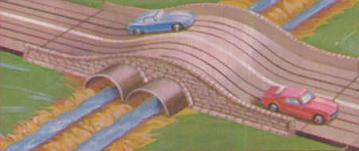
A 2-lane track system was also designed for these early model cars to run on. The first track system was marketed in England by Playcraft under the brand name Electric Highways Model Motoring.
This early track system was designed to be used with model train layouts. Straight tracks had a dashed white ‘passing’ line painted along the center of each section, and curved track sections had a solid ‘no passing’ stripe painted down their centers to better duplicate real highways. A railroad crossing section was also available.
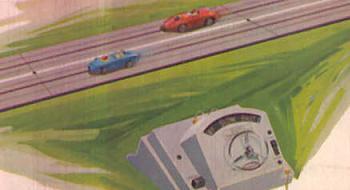
The very first boxed sets were powered by small AC power packs, or directly from the accessory circuit on transformers used to power model trains.
The speed of the cars running in the two lanes could be controlled individually using a pair of small controls with steering wheels connected to rheostats which varied the voltage to the power rails, and ultimately the cars’ motors.
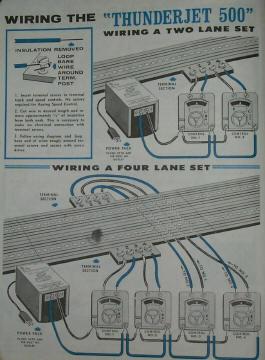
I often receive email from web site visitors asking how to wire their vintage Model Motoring tracks using the original set’s power pack and steering wheel controls. The diagram below should help those of you who have lost your set’s instruction booklet.
Aurora Model Motoring
The American model company, Aurora Plastics Corporation first saw the Playcraft Model Motoring system on display at an English toy fair and promptly acquired the marketing rights to the Model Motoring product line for sale in the U.S. Market.
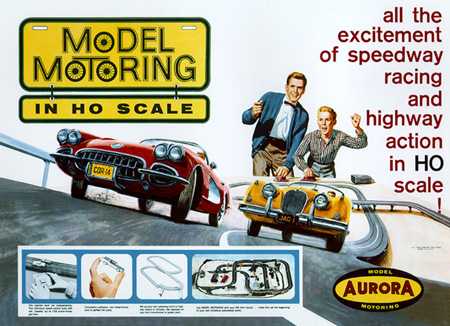
The Aurora Model Motoring system first appeared in U.S. hobby stores in 1960 just in time for the Christmas buying season.
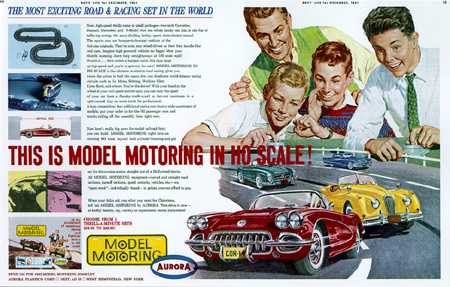
Hobby dealers often referred to these early sets as HO scale slot cars, although they were actually still the original English 1:76 ‘OO’ scale. Aurora made no attempt to correct this discrepancy in scales, and felt that the American hobbyist would be more accepting of the American ‘HO’ model railroading scale designation, than the ‘foreign’ OO scale.
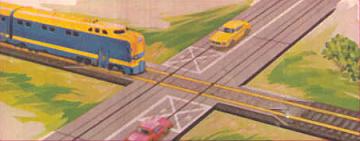
Most American model railroad sets sold in the early 1960’s where made by Lionel. Lionel trains were ‘O’ gauge, or 1:48 scale. The ‘HO’ scale was just beginning to gain in popularity. It was exactly half the size of the then popular ‘O’ gauge sets. The term HO actually means Half-‘O’ gauge or 1:87 scale.
Aurora ThunderJets
In 1963 Aurora introduced the Thunderjet 500 chassis in response to customers’ complaints about the difficulties they had keeping the original Vibrator cars running well. The Thunderjet 500 chassis, or just T-Jet, was designed so that the original Vibrator bodies could continue to be used with this new, faster and more maintainable chassis.
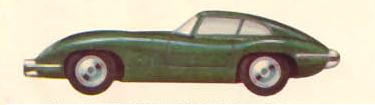
A Corvette String Ray and Jaguar XKE sportscar were added to the line, along with a front-engined Indianapolis racer and a rear-engined Grand Prix style F1 car.
The Thunderjet 500 chassis used a small DC motor mounted vertically in the chassis. The motor was attached to a small plate with idler gears ultimately driving a pinion and crown gear mounted on the rear axle.
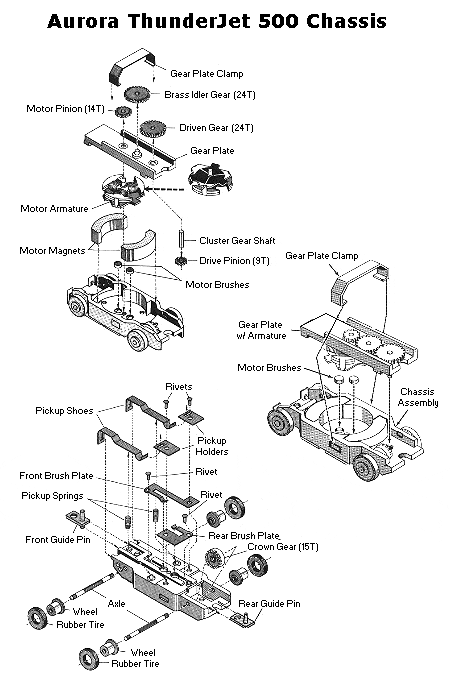
Replacement and Hop-Up Parts for this chassis are available in the ThunderJet section of this web site.
Aurora did not fail to realize that most of their customers were buying Model Motoring sets not just for use with HO model train layouts, but as stand-alone slot car racing sets.

In 1964, with racing in mind, Aurora began producing sets that included real racing cars. A Ferrari 250 GTO, Maserati, Ford Mustang and Cobra roadsters were made available in several colors each.
Aurora’s marketing shift from sedans and trucks that appealed primarily to model railroading enthusiasts, to true race cars which appealed to a much wider audience expanded the HO slot car racing market substantially. By 1965 over 25,000,000 HO slot cars had been sold by Aurora.
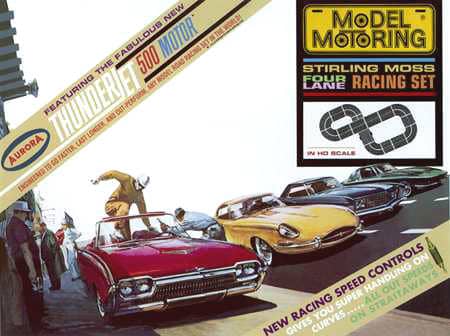
Meanwhile, back in England, ‘HO’ slot car racing had all but disappeared. Larger 1:32 scale slot car sets made by Scalextric dominated the U.K. market. Playcraft eventually went out of business, and Aurora opened a small sales office to service English owners of the original Playcraft Vibrator cars still in use.
Derek Brand continued to design new slot car chassis and was involved in the later development of both the Aurora A/FX and Tyco 440 Magnum 1:64 scale chassis.
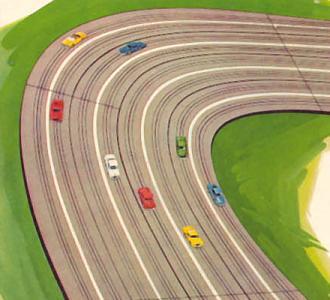
Aurora Model Motoring 8-Lane Track SystemAurora’s early success with HO slot car racing made it possible for them to expend the financial resources required to develop new and exciting products. A full line of track sections was added, making it possible to build large HO raceways with up to 8 lanes. New body styles were constantly being added to the line. In 1966 alone Aurora added several more race cars to their already impressive line-up. A Ford GT-40, Cobra GT Coupe, Porsche 904, Chaparral, Lola GT, Ferrari Dino and Ford MK-IV were all added to their catalog.
Boy’s Life Grand Prix Raceway
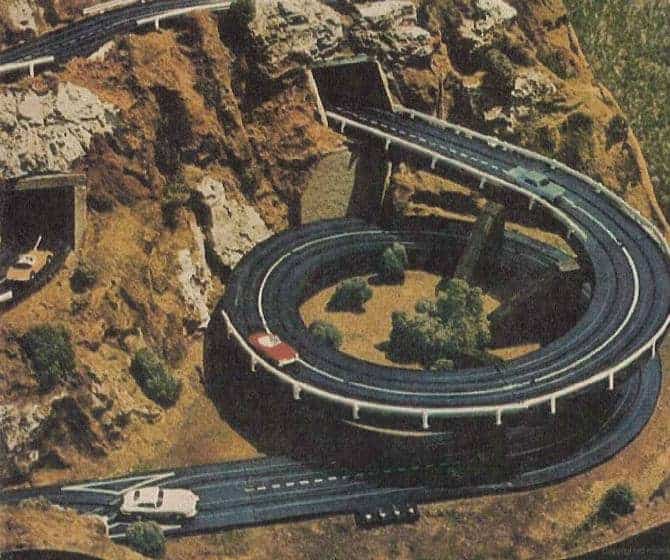
During the 1960’s HO slot car racing was as popular as video games are today. Most boys and their dads raced in the basement together. Many of the magazines of the day featured father & son projects involving carpentry and electrical wiring of elaborate HO model raceways.
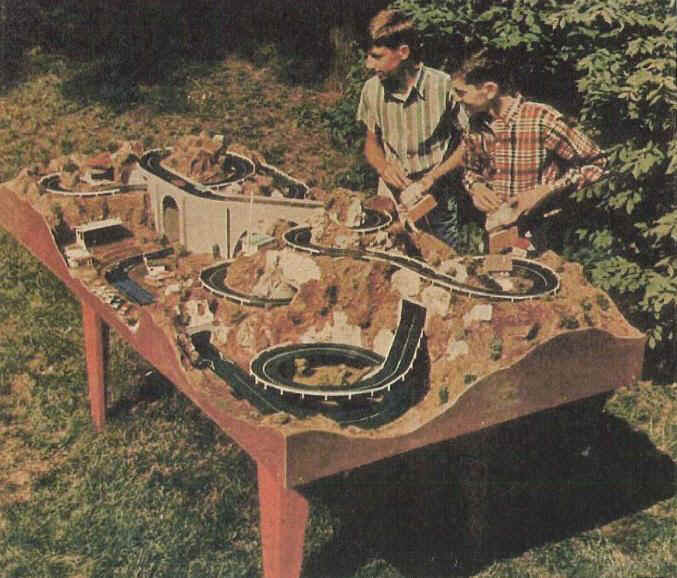
Boy’s Life Magazine was one of the most popular magazines in the 1960’s and it regularly featured HO slot car racing projects using Aurora Model Motoring track and accessories.
To view a reprint of the full article as it appeared in Boy’s Life in November of 1966 click your mouse on the Adobe PDF link here >>> Grand Prix Raceway.
Aurora’s remarkable success didn’t go unnoticed, and several other hobby companies attempted to get into the market. The most successful of these was Tyco, who in 1963 introduced its own line of ‘HO’ slot cars.
Tyco’s original cars were larger than Aurora’s Thunderjets. Tyco’s car bodies were closer to 1:64 scale then they were to the ‘HO’ scale. The slightly larger cars could still be operated on 3 inch wide track, of which Tyco offered its own track system, or on the many Aurora Model Motoring layouts that already existed.
Tyco’s decision to produce larger 1:64 scale cars made it possible for them to offer a more powerful motor and a simplified horizontally mounted motor with a pinion gear mounted directly on the armature shaft driving an axle-mounted crown gear.
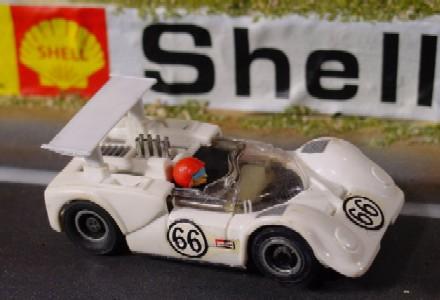
Tyco’s larger 1:64 scale chassis made it possible for them to offer cars with more realistic proportions and better details, not to mention being much easier to repair. The Tyco chassis also provided wide rear hubs and soft racing slicks that dramatically improved handling over the skinny ThunderJet rear tires.
Aurora Factory Experimental – A/FX
Aurora was quick to follow with a larger 1:64 scale chassis design of their own called the Aurora Factory Experimental or A/FX for short. The larger chassis made it possible for Aurora to produce bodies that were just as detailed as their competitor, Tyco’s offerings.
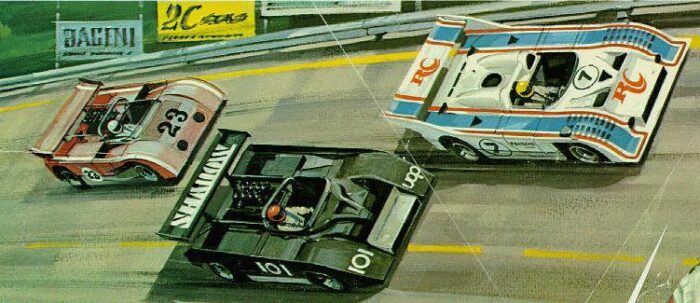
The Aurora AFX chassis wasn’t much more than a scaled up Thunderjet 500. It still employed the original vertically mounted motor and idler gears to transfer power to the rear wheels.
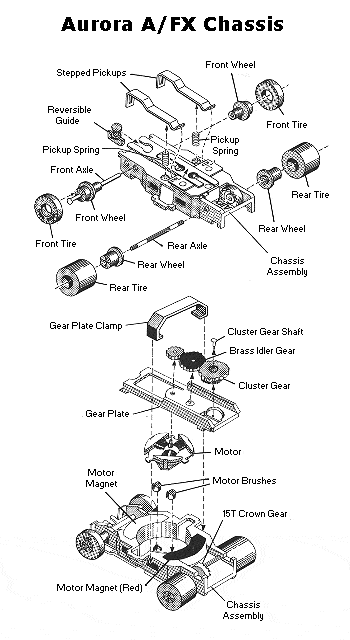
Replacement and Hop-Up Parts for this chassis are available in the A/FX section of this web site.
To this day the entire range of small slot cars produced by Aurora and Tyco are still referred to as ‘HO’ even though they never were actually 1:87 scale. From a purists point of view the original Model Motoring T-Jets were ‘OO’ scale and the later and larger A/FX cars were actually ‘S’ scale.
The new chassis design however, allowed for wide rear racing ‘slicks’, something that wasn’t possible on the original T-Jet without modifying the rear fender openings and fitting a pair of Aurora Hot-Rod hubs and slicks. These modified cars worked better than stock T-Jets but they weren’t very attractive with their rear wheels sticking way out past the fenders.
The new A/FX chassis design required new body moldings, large enough to fit over the larger chassis. Aurora continued to produce primarily race car body styles for this new chassis.
A new track system was also introduced. The Aurora A/FX Snap-Lock system offered smoother track joints and a slightly deeper slot. Adapters were made available to join the original Lock & Joiner style of track with the new Snap-Lock system. The white painted dividing lines were eliminated so as to make the track look more like a real race track surface.
Aurora A/FX Magna-Traction
The A/FX chassis, with its larger and more powerful motor magnets made it evident that if the magnets could be placed low enough in the chassis they would be attracted to the metal power rails in the track and allow the cars to stay in the slot better in the turns.
The original A/FX chassis was modified slightly to allow the magnets to be placed closer to the rails. The bottom of the chassis was opened up beneath the magnets and pockets were molded so that the motor magnets were now exposed and much closer to the metal power rails.
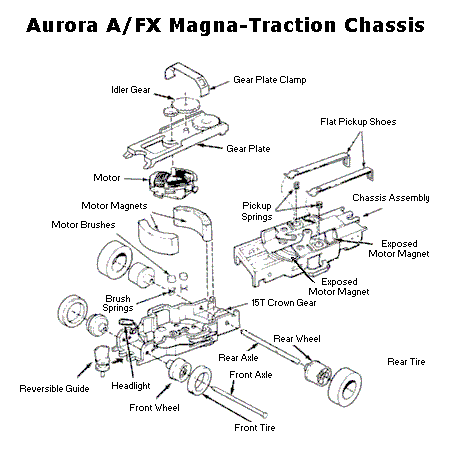
Replacement and Hop-Up Parts for this chassis are available in the Magna-Traction section of this web site.
The A/FX Magna-Traction chassis was really nothing more than a variation of the original A/FX chassis which itself was just a scaled up T-Jet. While the A/FX Magna-Traction chassis was an improvement over the original T-Jet, Aurora drastically needed a modern chassis that could go head-to-head against the best of what Tyco had to offer.
Aurora G+Plus
Aurora realized that in order to compete against the more powerful Tyco chassis they would have to design a new chassis that abandoned the pancake-style motor in favor of one that used the same simplified horizontally mounted motor arrangement that had made Tyco slot cars so successful.
Aurora introduced an all-new chassis design they called the A/FX G+Plus. The G+Plus was an instant success. Not only could it use the same bodies the earlier A/FX and Magna-Traction cars had used, but by mounting the motor armature horizontally they were able to place the motor magnets directly above the power rails for a dramatic increase in magnetic downforce.
Replacement and Hop-Up Parts for this chassis are available in the G+Plus section of this web site.
Aurora’s G+Plus chassis development closely paralleled developments in real race car designs of the day. Colin Chapman’s Lotus F1 car designs from this same era employed revolutionary aerodynamic techniques to increase downforce, or what was often called ground-force. Aurora’s G+Plus chassis was touted as the most advanced slot car design of its day, and it was!
The wide and low-slung A/FX G+Plus chassis also made it possible to produce some strikingly beautiful Formula 1 and IndyCars bodies from the early 1970’s.
The Lean Years
The early 1970’s brought about a drastic decline in interest for slot cars. Many of the original slot car racers that had made Aurora so successful throughout the 1960’s were now getting older. As they graduated from High School and went off to college their HO slot car sets were moved to the attic, or sold at garage sales.
Aurora’s annual sales in 1970 were at an all-time high of $20 million dollars. In the years that followed annual sales began to drop dramatically. Each year saw an ever larger decline in revenue.
By the end of the 1970’s it was evident that the slot car boom that had been so successful in the 1960’s was all but over. Many things contributed to this decline, but it was primarily from the loss of a customer base. As the baby boomers moved on to college and then started families of their own slot cars took a back seat to more pressing issues.
…More to Come…